


There is a moment early in Belly of the Beast where the story seems to begin, undo itself, and begin again. A weaver builds something whole; a trickster crow unravels it; she starts over. It is not an accident that this is where the play chooses to open.
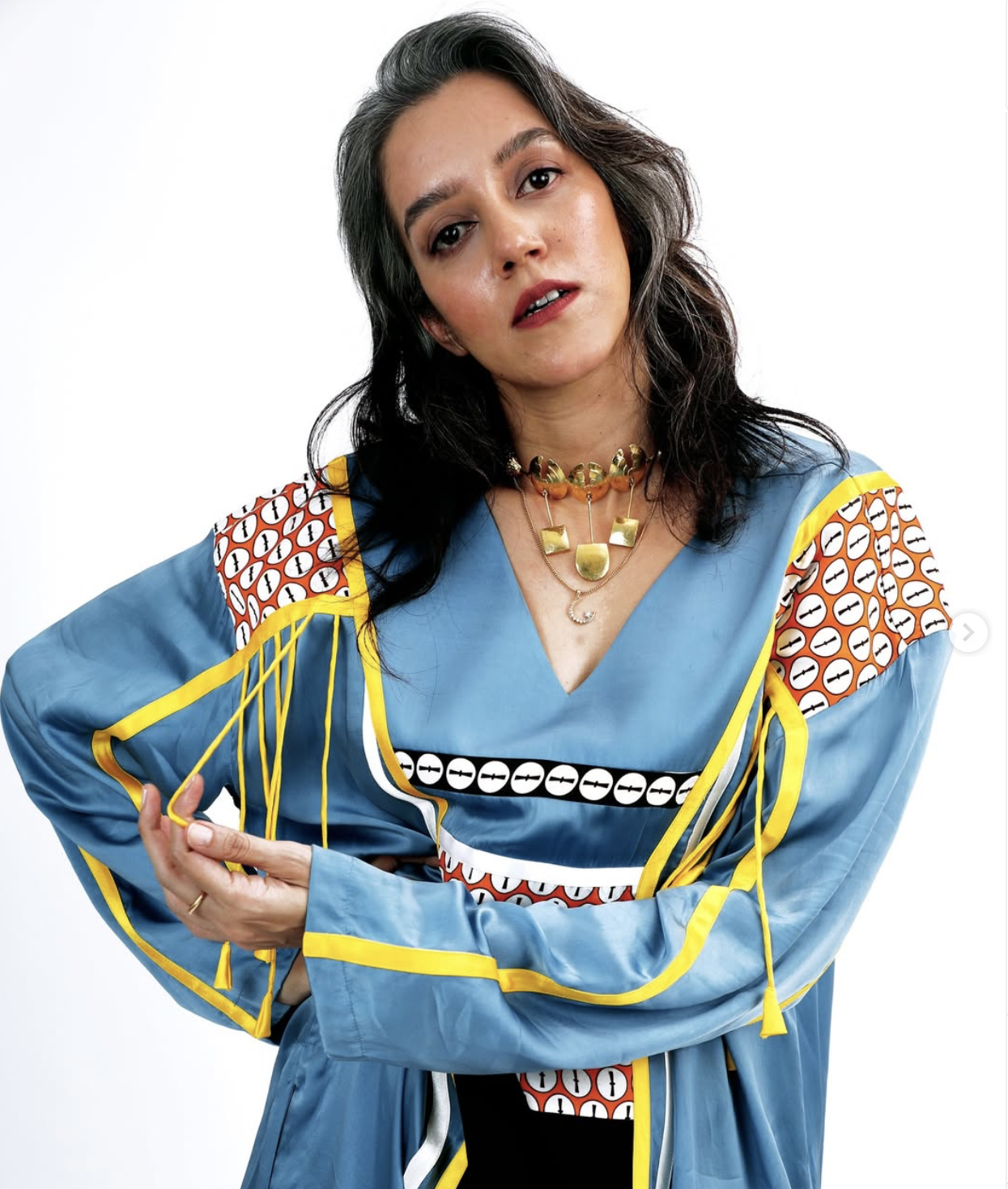
"It came from when we were doing our research," says director Sheena Khalid. Kalki Koechlin had come across a folk tale about a Weaver of Worlds, a story about beginning something, watching it come undone, and having no option but to put it back together and start again. "That kind of became one of the through-line structures we wanted to work with in the show."
It is, in other words, exactly what motherhood is.
Table of contents [Show]
- Where the Story Begins: Kalki Koechlin on Writing The Elephant in the Womb
- What "Beast" Means: Kalki Koechlin, Sheena Khalid & Rachel D'Souza on the Play's Title
- Kalki Koechlin on the Hardest Chapters to Write, Including Her Abortion
- Sheena Khalid on Adapting The Elephant in the Womb for the Stage
- Shadow Puppetry in Belly of the Beast: The Anurupa Roy Collaboration
- Rachel D'Souza on Playing Violet and Researching Hyperemesis Gravidarum
- Postpartum Depression in India: What Didn't Make It Into the Play
- Fatherhood in Belly of the Beast: Kettan Singh's Multiple Roles
- Kalki Koechlin on How Motherhood Changed Her Relationship With Her Own Mother
- The Live Music of Belly of the Beast: Guy Hershberg's Score
- Aadyam Theatre's Role in Bringing Belly of the Beast to the Stage
- What Kalki Koechlin and Rachel D'Souza Hope Audiences Remember
Where the Story Begins: Kalki Koechlin on Writing The Elephant in the Womb
Long before the folk tale, before the stage, before Sheena Khalid came on board the story began with Kalki Koechlin, alone, in lockdown, newly postpartum, and cut off from the world.
"It needed to be told for myself, in the beginning," Kalki says. "I was going through postpartum when we were in lockdown, and it was a very isolating period, the world just shut down completely on us. We had to handle this new life all by ourselves, without family or anyone around."
A few mothers told her something simple: write it down, because you forget. So she did - a diary that eventually became The Elephant in the Womb, illustrated by Ukrainian artist Valeriya Polyanychko. But one book wasn't enough.
"The more mothers I met as I became a mother, the more I realised how different our stories can be and yet there are some universal, unifying factors we all go through," Kalki says.
That realisation is what led her to Sheena Khalid, a theatre director known for her devising work. A proposal went to Aadyam Theatre. The rest, as Kalki puts it, is history.
What "Beast" Means: Kalki Koechlin, Sheena Khalid & Rachel D'Souza on the Play's Title
Ask each of them what the word "beast" means, and no two answers land the same way, which may be the entire point.
For Rachel D'Souza, who plays Violet, the vampire, the beast is something unglamorous by design. "It's not poetic, lyrical, gentle. It's rugged," she says. "The images we see of pregnant women are very poetic, very beautiful and there are sides to it that are quite ugly, quite dark, quite isolating. A beast typically lives in a cave, some dark place, and when it comes out, it's not pleasant to look at." Pregnancy, she says, is an unknown beast the first time; it's something you can read about, watch in films, prepare for, and still be entirely unprepared for.
For Kalki, the beast is what has to be faced before motherhood can be embraced at all. "There is this extremely difficult time where you don't know who you are anymore, where you lose your identity," she says. "There's so much pressure for you to enjoy it, to be this perfect bubble but it's actually exhausting, tiring, mind-numbing. Sometimes it makes you go mad." Facing that darkness, she believes, is the only way to eventually reign it in to become the powerful mother on the other side of it.
Sheena adds one thread to both answers: power.
"The physical power that the female body is able to harness and then the mental and emotional power that experience like this requires," she says.
Kalki Koechlin on the Hardest Chapters to Write, Including Her Abortion
Some parts of The Elephant in the Womb came easier than others. Kalki is candid about which didn't.
"I was nervous about writing about my abortions," she says. "It's a very taboo subject but that's the one thing we never talk about. So many people I know have had abortions and don't talk about it." The postpartum chapters were harder still, in a different way: how do you make something feel real to someone who hasn't lived it? Illustration helped. So did humour, "it helps you break a wall and get through to people," she says.
And then there was her daughter. "She was so young, and she was just part of a puzzle I hadn't put together yet," Kalki says. "I was still figuring out who she was. That was a hard chapter to write."
Sheena Khalid on Adapting The Elephant in the Womb for the Stage
If Kalki's task was excavation, Sheena's was architecture. Compressing five women's journeys into a single production meant deciding, again and again, what the play could and couldn't hold.
"I don't know if it's an adaptation of the book — but I think the book is very much a starting point," Sheena says. What she wanted to preserve wasn't the plot, but a quality: the way the book moves from the everyday and mundane into the magical, the surreal, the humorous. That constant shifting of registers became the spine of the stage production too.
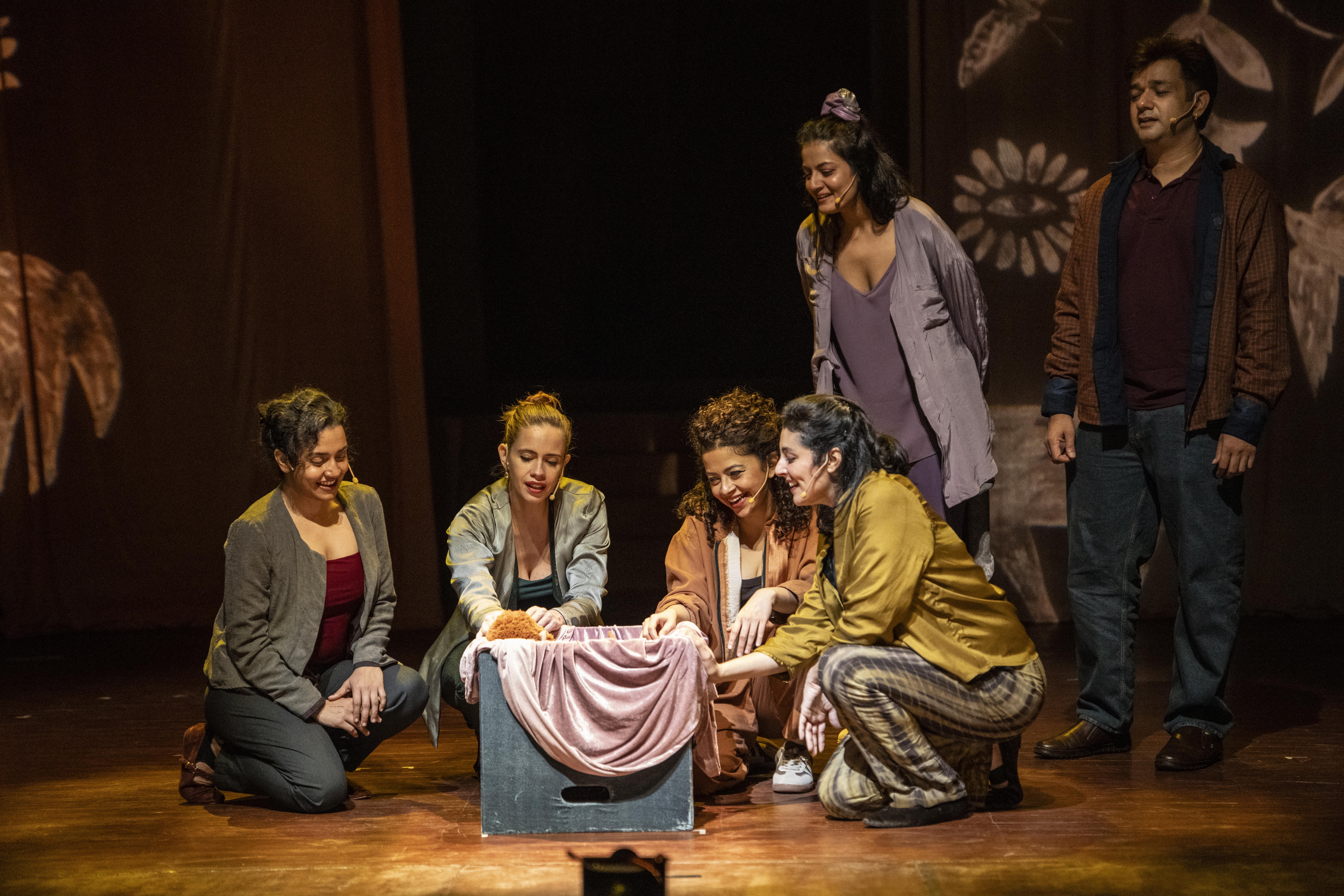
Much of the play wasn't scripted in advance so much as built. "So much of the work we've done in the rehearsal room, the actors have created," Sheena says the characters, the dialogue, the stories, all shaped collaboratively before being folded into a coherent whole.
Shadow Puppetry in Belly of the Beast: The Anurupa Roy Collaboration
The play's shadow puppetry designed with acclaimed puppeteer Anurupa Roy does something rare: it visualises the parts of motherhood that resist language. A birthing scene, a C-section, a sparrow named Spark, and many more visuals drifting across the stage.
The collaboration began early, with a workshop that Sheena remembers as pure play, in the truest sense. "We weren't really looking much at the text," she says. "She came in with all of these wonderful puppets. We borrowed an overhead projector from a friend who runs a theatre and we just played." None of the actors had worked in this form before. Watching them pick it up, Sheena says, was its own kind of revelation, and puppetry, it turns out, has its own language of storytelling, dictated by how you place a puppet, how you take it away.
Rachel D'Souza's character, Violet, carries one of the play's more physically brutal threads, the hyperemesis gravidarum, a severe, debilitating form of pregnancy sickness. Rachel didn't experience it herself; researching it for the role changed how she thought about the condition entirely.
"Sometimes we're starving for an acknowledgement of how impossibly hard something is," she says. "If someone says it's an extension of morning sickness but to what extent is that true? It's not that. It's something so debilitating, it takes the ground away from under your feet. You lose weight, you lose your sense of self and you're doing it all while carrying a child, moving toward something so positive, so wanted, while something so undesirable is happening to you constantly."
Researching further, Rachel found herself drawn into darker territory still - C-sections that go wrong, the moments in an operating theatre when a site of birth can become a site of death. It's a fear that stayed with her long after rehearsals: what happens if someone doesn't make it? What if you have the baby, and not the mother?
Postpartum Depression in India: What Didn't Make It Into the Play
Not everything found room in the play and both Sheena and Kalki are clear-eyed about what didn't.
"That is something that didn't get space in the show," Sheena says of postpartum specifically, calling it one of the most moving chapters in Kalki's book. Kalki agrees, pointing to how closely birth and death sit together in that period - the paranoia of checking, over and over, whether a newborn is still breathing. "Postpartum takes that to a psychological landscape," she says. "We did attempt to put it in, but there's only so much you can make an audience sit through. Now that we've seen the show in front of an audience, we know what's working, what's not; where to edit, where to add. That's what's beautiful about theatre. It's a developing beast."
Fatherhood in Belly of the Beast: Kettan Singh's Multiple Roles
One actor, Kettan Singh, plays nearly every man in the story; a father, a husband to three different characters, a doctor, even a driver standing in for a husband who's rarely present. It's a deliberate structural choice in a play that, by design, keeps its lens on mothers.
"Our play really does focus on mothers," Kalki says. The one moment fatherhood gets fuller space is Kettan's final scene as Gautam, grappling with his own inadequacy; a father who asks “am I the monster?”, unsure how to meet a wife's desire, unsure how to hold a family of three children. "In real life, of course, we need a serious paternity leave, not one or two weeks," Kalki adds. "Fathers need the space to be present for the early stages, to be hands-on."
Rachel, reflecting on fatherhood more broadly, points to something structural: pregnancy is, biologically, something a father can only witness from a certain distance. "I see fathers coming ahead and talking more, especially in the early years but there aren't too many stories yet," she says. What she hopes for is a shift from the "provider space" to the “caregiving space” a presence that goes beyond simply holding the bag at a hospital appointment.
Kalki Koechlin on How Motherhood Changed Her Relationship With Her Own Mother
Motherhood, Kalki says, didn't just change how she saw herself, it also changed how she saw her own mother. "My mother and I have a difficult relationship. We fight a lot," she says. "But after birth, I was asking a hundred questions about her youth, her experiences of birth and parenting. I wanted to know everything about her."
The Live Music of Belly of the Beast: Guy Hershberg's Score
Composed by Guy Hershberg, with live percussionist Varun Gupta, the score isn't a backdrop to Belly of the Beast it behaves, according to Sheena, almost like another character in the room. "The music is dialogue," she says. "It picks up a thread of the emotion, heightens it, diverts it, changes it, it works with the rhythm of the scene." Guy was present through the long rehearsal days, not just composing from a distance but performing live alongside the cast, in sync with the actors and, visibly, with his fellow musician a connection Mapabear noticed too, watching from the audience.
Aadyam Theatre's Role in Bringing Belly of the Beast to the Stage
Behind a story this intimate was a production house willing to back it at scale. Sheena, who had never directed anything approaching this size before, credits Aadyam's team Nadir, Akash, Rajna among them for making the leap possible. "I have never even conceived of staging something on such a massive stage," she says. "The kind of support the team gave has been incredible - technically, logistically, in every way. It's been a scary, overwhelming experience, and the fact that they've been there through it and that meant everything."
What Kalki Koechlin and Rachel D'Souza Hope Audiences Remember
Asked what she hopes audiences carry with them, Kalki resists a single tidy takeaway. "I don't know if there's one particular thing," she says. "But if it evokes any memory of you as a parent, or of your own parent, or your children that, for me, has been the most valuable thing." She recalls a sixty-year-old man approaching her after a show to talk about his wife's miscarriage; a young woman with no children of her own, saying she related to all of it anyway. Different paths, she says, reaching different people. "The memory that we are all connected to this, somehow or other."
Rachel's answer circles back to something she says near the end of the play itself about the healing power of simply telling a story. "I think it's a form of healing," she says. "Even if you've only gone through some part of it, or someone in your family has, there's something curative about storytelling itself." The play, she points out, is really a series of vignettes, small windows into different lives. If even one of them leaves someone feeling comforted and held that would be enough.
Belly of the Beast, an Aadyam Theatre production, completed its Delhi and Mumbai runs this July. Co-written by Kalki Koechlin and Sheena Khalid, and directed by Sheena Khalid, with shadow puppetry by Anurupa Roy and a live score by Guy Hershberg and percussionist Varun Gupta, the team is now exploring future cities for the show's next chapter.
 Guiding and Empowering Parents with fact-checked excellence -