


Editorial note: This is a developing story. APAAR ID policy is being actively shaped by an ongoing Supreme Court case and evolving CBSE and state-board notifications. We've sourced every claim below and flagged (in amber) the handful of details that are still being independently verified. This article will be updated as those are confirmed.
Color key: highlighted amber text marks claims still pending independent fact-check.
There is a particular kind of form that lands in a parent's hands somewhere between the admission counter, the WhatsApp class group, and email; It's a form that asks, almost in passing, for a child's Aadhaar number "for the APAAR ID." Most parents sign it the way we sign most school paperwork: quickly, trustingly, without quite knowing what it commits our child to.
At Mapabear, we think that deserves a second look. Not because APAAR is something to fear, it isn't, but because any system that creates a permanent, government-linked digital record of a child, starting as early as preschool, is worth understanding properly before a parent puts their signature to it. This is not a listicle of steps. It is an editorial attempt to give you the fuller picture: what APAAR actually is, what it is genuinely useful for, where the confusion and controversy lie, and most importantly what your rights as a parent are in this process.
Table of contents [Show]
- What APAAR Actually Is
- How It Actually Gets Created
- The Part Most Explainers Skip: It Is Officially Voluntary But Doesn't Always Feel That Way
- Where APAAR Has Become Practically Necessary And Where It Hasn't
- What This Means, Practically, for Different Parents
- The Mapabear View
-
If You Say No Now, Can You Say Yes Later?
- This won't be the last form that asks for more than it explains. Mapabear will keep breaking these down, honestly. Want to be part of that conversation? Join the Mapabear Community Circle, and find your stage: family planning, pregnancy, parents, newborn/infant, toddler, or kids (0–10). → https://chat.whatsapp.com/G7LD67AlQtXDz5Mianjzvj
- {
What APAAR Actually Is
APAAR stands for Automated Permanent Academic Account Registry. It is a 12-digit identification number issued by India's Ministry of Education, built around the "One Nation, One Student ID" vision under the National Education Policy (NEP) 2020, and administered through the official APAAR portal. In plain terms, it is meant to function as a lifelong digital folder for a student's academic life; report cards, transfer certificates, scholarships, co-curricular achievements, and eventually, credits earned across schools and universities, all stored digitally and linked to the student's DigiLocker account.
The idea behind it is genuinely sound. Indian families know the anxiety of a lost transfer certificate, a mark sheet gone missing in a house move, or a scholarship application delayed because an original document couldn't be located in time. APAAR, on paper, is designed to solve exactly this, an unbroken academic record that follows a child from their earliest years of schooling into college and career, without depending on a single physical file.
The scheme officially applies across the entire academic spectrum from pre-primary and preschool learners through school, undergraduate, and postgraduate education though in practice, its visibility and urgency have been concentrated at the school-leaving and board-exam stages so far.
How It Actually Gets Created
For a young child, APAAR ID generation is almost always school-led, not something a parent does independently online. It typically works like this:
- The school verifies the child's basic demographic details against its own records, usually through the government's UDISE+ system.
- Parents are asked to sign a consent form, authorising the school to use the child's Aadhaar number (or another accepted government ID) to generate the APAAR ID.
- On verification, a 12-digit ID is generated and linked to a DigiLocker account associated with the child.
Older students and adults can also generate or access their own APAAR ID independently through the DigiLocker app or the Academic Bank of Credits (ABC) portal. There is no fee involved at any stage - this is a free government service, and any request for payment linked to APAAR registration should be treated as a red flag.
One detail worth holding onto: the child's Aadhaar number itself is meant to be masked in the APAAR system, visible only for the limited purpose of verification, not displayed or shared in full.
The Part Most Explainers Skip: It Is Officially Voluntary But Doesn't Always Feel That Way
This is where Mapabear wants to slow down, because it is the part that matters most to parents, and the part that gets glossed over in most guides.
The Ministry of Education has consistently described APAAR as a voluntary initiative. Yet parents across the country from metros to smaller towns have reported a different lived experience: schools linking APAAR registration to admission confirmations, exam registrations, or general administrative cooperation, sometimes implying that a child's continued enrolment depends on it.
This tension became a matter of formal legal record in 2025 and 2026. A father of a kindergarten-age child in Odisha challenged his school's consent process in the Orissa High Court, arguing that the form did not genuinely reflect the government's own position that the scheme was optional. Justice Sashikanta Mishra agreed, directing the Ministry of Education to amend the model consent form to explicitly include an option to refuse consent not just to give it.
The matter then reached the Supreme Court of India through a writ petition that questioned whether an Aadhaar-linked, lifelong educational database for children was compatible with the constitutional right to privacy, and whether consent obtained under implicit pressure could be considered genuinely informed. In its ruling, a three-judge bench led by the Chief Justice of India declined to strike down the APAAR scheme itself, but it directed authorities nationwide to ensure that:
- Every consent form must clearly and explicitly offer parents the option to opt out, not just to opt in.
- All collection, storage, and sharing of a child's data under APAAR is subject to the Digital Personal Data Protection Act, 2023 - meaning it cannot be used or shared beyond its stated, lawful purpose.
For parents of preschoolers and young children in particular, this ruling matters enormously. It is a reminder from the country's highest court that consent for a young child's data is not a formality. It is something a parent is entitled to question, understand, and, where they choose, decline.
This is precisely the kind of conversation Mapabear exists to surface: not fear, not refusal for its own sake, but informed, respected autonomy for the child whose data this is, and for the parent making the decision on their behalf.
Where APAAR Has Become Practically Necessary And Where It Hasn't
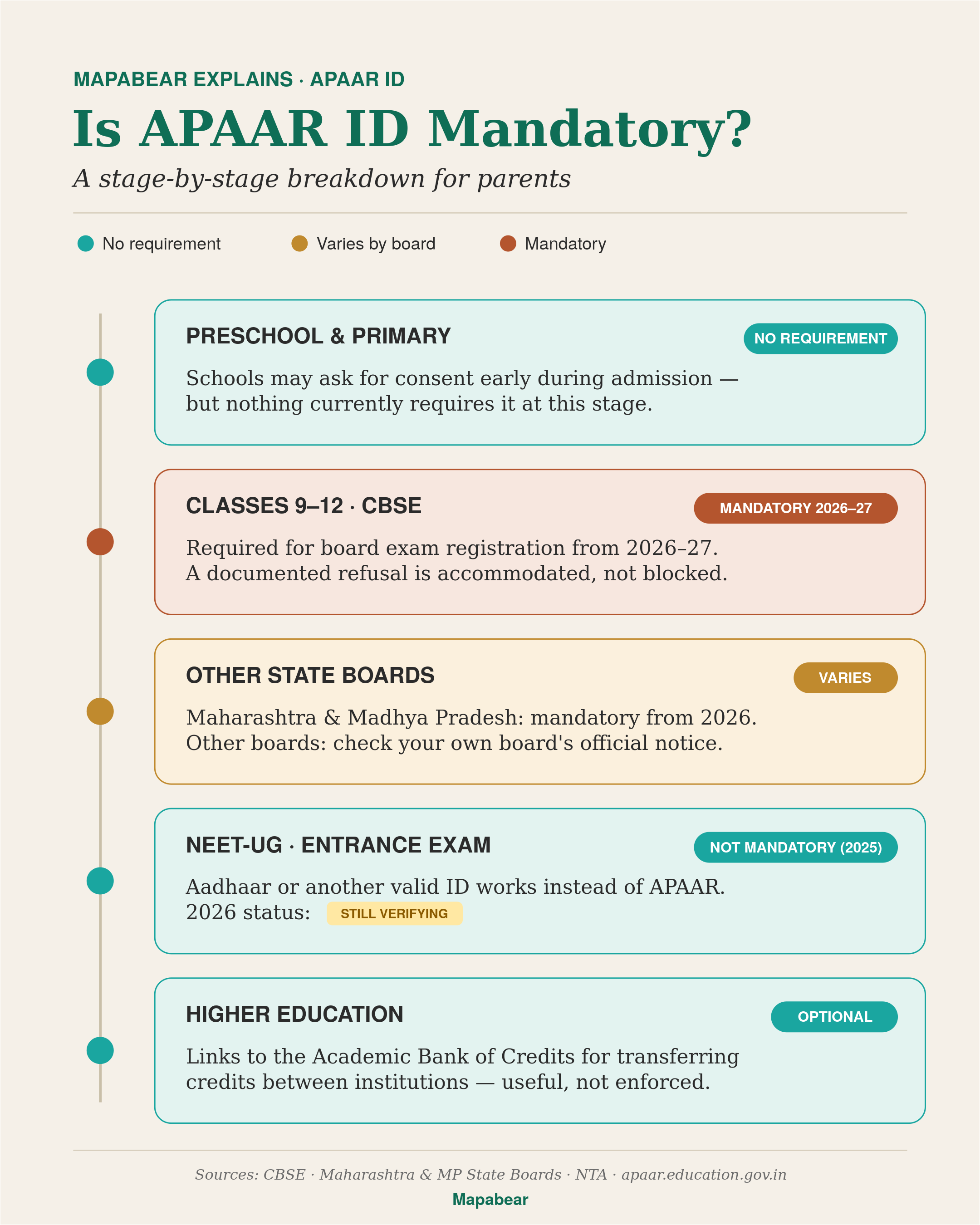
Because "voluntary" and "practically unavoidable" are not always the same thing in the Indian education system right now, here is the current, verified picture, as of this writing:
Board examinations (Classes 9–12):
The CBSE has stated, via official circular, that from the 2026–27 academic session, students of Classes 9 to 12 will need to provide their APAAR ID while registering for board examinations. The board's own data reveals just how uneven adoption still is in some states, fewer than 1 in 5 eligible students currently hold an APAAR ID, while in others, adoption is closer to half. It's worth knowing that CBSE has since eased this requirement in practice: schools facing a parent's refusal, or a genuine technical hurdle in generating the ID, can now mark the student's entry as "refused" or "not generated" on the official candidate list rather than being blocked from registering the student at all. In other words, the mandate is real, but a parent's documented "no" is meant to be accommodated within it, not overridden by it.
Other boards, beyond CBSE:
The picture isn't uniform nationally, and it's worth checking your specific board rather than assuming CBSE's timeline applies to you. Maharashtra's state board (SSC/HSC) independently made APAAR mandatory for its own board exams starting 2026. Madhya Pradesh kept the ID optional for the 2025–26 session as a transitional relief, but has confirmed it becomes compulsory from 2026–27, broadly aligning with CBSE's own timeline. ICSE/CISCE and several other state boards are moving in the same general direction, but without a single, uniform national deadline as of this writing. (This particular point is still being sourced against a specific board notification — treat it as a general trend rather than a confirmed rule for your board.)
Competitive and entrance exams:
Here, the picture is more reassuring than many parents assume with one timing caveat worth being precise about. The National Testing Agency explicitly clarified for NEET-UG 2025 that APAAR was not mandatory for registration, and students could use Aadhaar or another valid ID instead. For the 2026 cycle, the picture is less settled: an APAAR ID field now appears within the NEET UG 2026 application form itself, though at the time of writing there is no fresh, equally explicit confirmation from NTA on whether it remains optional or has quietly become a practical requirement. (We're actively verifying this against the current NTA information bulletin and will update this section once confirmed.) Parents of exam-stage students should treat this as a "check the current year's official information bulletin at neet.nta.nic.in before assuming" situation, rather than a settled fact carried over from 2025.
It's worth understanding why that gap between "mandatory for boards" and "not confirmed as mandatory for NEET" exists, rather than reading it as a loophole. NEET-UG eligibility is tied to a candidate having passed, or being in the final year of, Class 12, not to any standalone Class 10 requirement and it draws candidates from every school board in the country, not CBSE alone. Because CBSE's own APAAR mandate covers board registration for Classes 9 through 12, a CBSE student sitting their Class 12 boards from 2026–27 onward will, in effect, already hold an APAAR ID by the time they apply for NEET - simply as a byproduct of registering for boards. But NEET also draws heavily from state boards, ICSE, and other systems where APAAR adoption remains patchy or entirely absent. Making APAAR compulsory at the NEET-registration stage itself would risk shutting out capable students from boards or states where the ID simply isn't yet in wide use, which is precisely the "digital exclusion" concern that privacy advocates have raised about the scheme more broadly. Whatever NTA ultimately decides for a given year, that tension is the reason this space keeps shifting.
Preschool and primary years:
For younger children, there is currently no examination-linked mandate requiring an APAAR ID. What parents are more likely to encounter at this stage is a school-initiated consent form, often introduced during admission or a parent-teacher meeting, well ahead of any regulatory requirement. This is exactly the stage at which the Supreme Court's opt-out safeguard is most relevant and most parents don't realise it applies to them, too.
Higher education:
For college and university students, APAAR connects to the Academic Bank of Credits (ABC), which allows credits earned at one institution to be banked and transferred to another - genuinely useful for students who switch institutions, take a break from study, or pursue multidisciplinary combinations under NEP 2020.
What This Means, Practically, for Different Parents
For parents of preschoolers and primary-stage children, the most important thing to know is this: you are very likely being asked to consent earlier than any policy actually requires. That doesn't make the request illegitimate - many schools are simply preparing early, and there is genuine long-term value in an early academic record. But it does mean you have the room, and now the explicit legal backing, to ask questions before signing: Who has access to this data? What happens to it if we change schools or move states? Can we revisit this decision later?
For parents of children in Classes 9 to 12, the calculus is more straightforward: the ID is on its way to becoming a practical requirement for board exam registration, and delaying it is likely to create last-minute stress rather than protect against anything. Early registration through the school, once you're comfortable with the consent terms, is the more sensible path.
For parents of students preparing for entrance exams, it's worth knowing that the absence of an APAAR ID does not currently lock a child out of appearing for exams like NEET-UG, though having one is still described as useful for future counselling and admission processes.
The Mapabear View
We don't think APAAR is something to be alarmed about. A well-implemented, well-protected digital academic record could genuinely spare Indian families decades of paperwork anxiety and that matters, especially for children whose families move cities, change schools, or navigate the education system without the safety net of institutional privilege.
But we also don't think "it's mandatory now, just sign it" is an honest way to talk to parents about a system that stores a child's data for life. The Supreme Court's insistence on a genuine opt-out option exists precisely because informed consent for a minor is not supposed to be assumed - it is supposed to be actively, clearly offered. That is not bureaucratic fine print. It is, at its core, a question about a child's right to autonomy over their own information, held in trust by the adults responsible for them.
Ask the questions. Read the form. Decide with intention. That, more than any checklist, is what APAAR actually asks of Indian parents right now.
If You Say No Now, Can You Say Yes Later?
This is one of the most common follow-up questions we hear from parents, especially those with children still in the preschool and early primary years, and it deserves a straight answer: yes, and there is no deadline attached to it.
Declining to consent right now is not a one-time offer that expires. The Ministry's own consent form states plainly that refusing an APAAR ID at this stage will not affect a child's admission, promotion, or access to any government benefit. It is a standing "not now" - one you can revisit whenever you feel informed and ready, whether that's next term, next year, or when your child moves into a higher class. There is no re-application window or age-linked cutoff, since the scheme itself spans pre-primary through higher education.
The reverse protection exists too, and it's worth knowing precisely because it shows the door swings both ways: parents who do consent now retain the right to withdraw that consent later, in writing, at any time. This is explicitly protected under Section 6(4) of the Digital Personal Data Protection Act, 2023, which requires that withdrawing consent be made as simple as giving it in the first place.
One honest caveat, in the interest of giving parents the full picture rather than a comforting half of it: consent generally isn't retroactive in effect. If a parent who had consented earlier withdraws later, data already processed up to that point typically isn't erased - withdrawal stops future use, it doesn't undo the past record. This complication doesn't apply to a parent moving from "no" to "yes" later, since nothing would have been collected in the interim.
For a preschooler's parent weighing this decision, the practical takeaway is simple: this is genuinely your timeline to set, not the school's. It's entirely reasonable to ask, in writing, that your "not now" be treated exactly as the Ministry's own form promises with no bearing on your child's place in the classroom.


 Guiding and Empowering Parents with fact-checked excellence -